
Burns suffered nearly ten years ago still caused a 14-year-old boy discomfort, interrupted normal activities like eating and talking, and even impacted his self-esteem.
Enter Jessica Canallatos, DDS, MS, prosthodontist, and Robert Perry, MD, FACS, administrative director, medical director of plastic surgery, at the Laurence C. Wright Craniofacial Center.
Where many other doctors saw unmalleable scar tissue, Doctors Canallatos and Perry saw promise and a chance to restore his quality of life.
“When I first met him, I knew there were devices that could stretch his lip, but I wanted to create something customized, something that made sense for his function and that he wouldn’t have to hold in place with his hands,” Dr. Canallatos recalls. “As a prosthodontist, I love being able to think outside the box and make something unique for each patient. That’s just how we’re trained – to design solutions that don’t yet exist. What makes the Craniofacial Center so special is our multidisciplinary approach. We collaborate constantly, which allows us to combine ideas and skills to truly improve a child’s outcome. It’s amazing to see a child not only smile or eat more comfortably, but also feel more like themselves again. Scars tell a story of resilience, and with a team approach, we can help soften their appearance and restore both function and confidence.”
The teen began to see Dr. Canallatos and Dr. Perry at the Laurence C. Wright Craniofacial Center at Oishei Children’s Hospital (OCH). His parents explained that, after attempting to unplug a device with his mouth when he was just six years old, he had suffered electrical burns in his mouth. Because of the way the scar tissue had formed, the boy had a reduced ability to open his mouth before he felt pain or discomfort – just 22 mm. For reference, the National Institute of Health (NIH) estimates that the average maximal incisal opening (ability to open mouth without pain) for a 14-year-old male is approximately 51 mm.
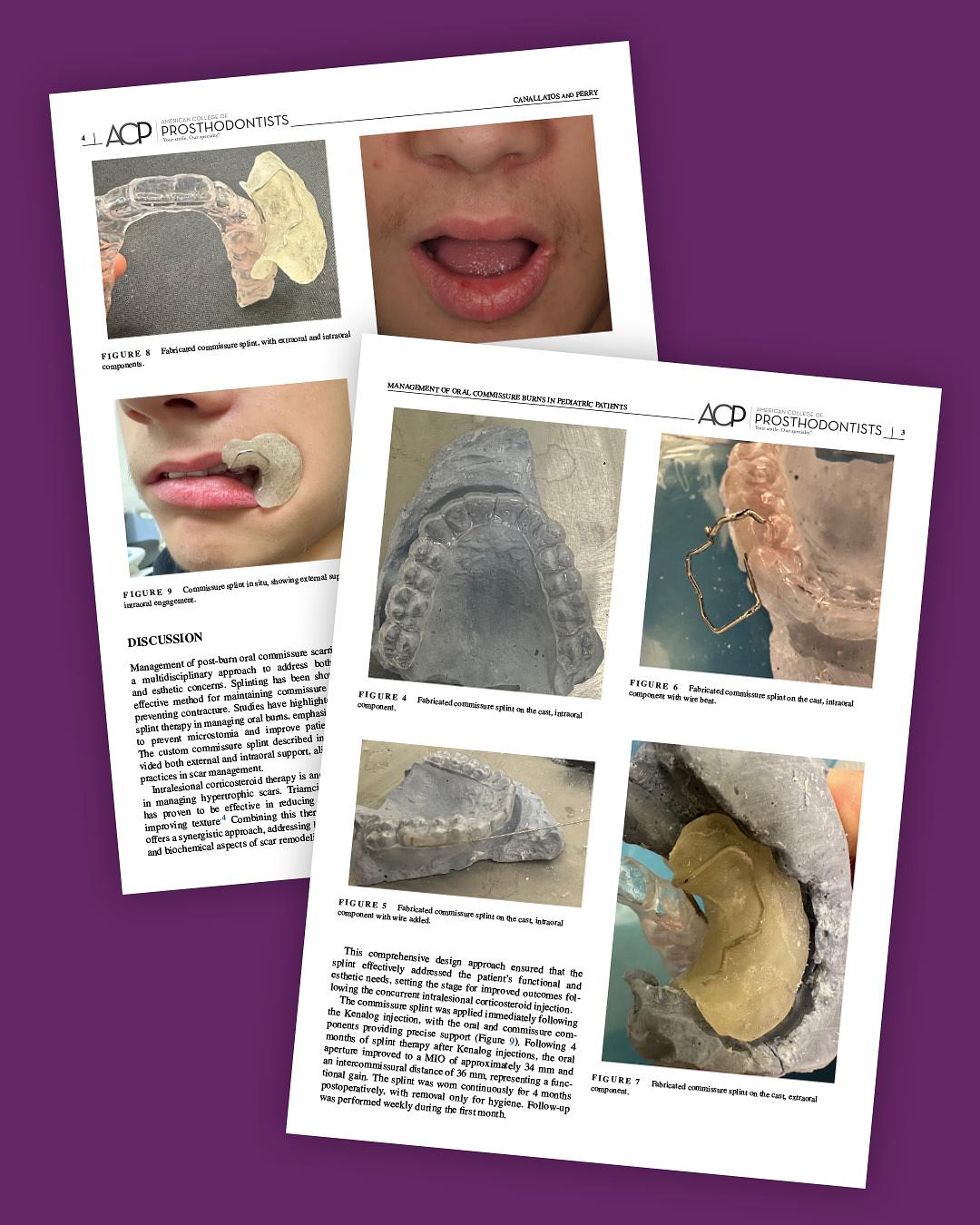
Dr. Canallatos and Dr. Perry began formulating a plan involving a splint made from an impression of the child’s mouth. The hope was that, with enough time, the splint would slowly and gently force the scar tissue wider and wider, increasing his range of motion without pain. This splint was paired with corticosteroid injections to reduce the amount of scar tissue.
Four months later, Dr. Canallatos and Dr. Perry were thrilled to hear that the splint and injections were a great success! The patient experienced less resistance when opening his mouth, and eating and talking were much easier and more comfortable. His maximal incisal opening had also increased to 34 mm!
You can read more about this case study in “Multidisciplinary approach to the management of oral commissure burns in pediatric patients: A case report,” Dr. Canallatos’ and Dr. Perry’s case report that was recently published by the American College of Prosthodontists.