
“Cytotechnologists are thinkers and problem-solvers, and play an integral role in a team of diagnosticians. We are the eyes fighting against cancer.”
Kelly Lennen, Thomas Jefferson University’s College of Health Professions
Cytotechnology might be the most important field you’ve never heard of
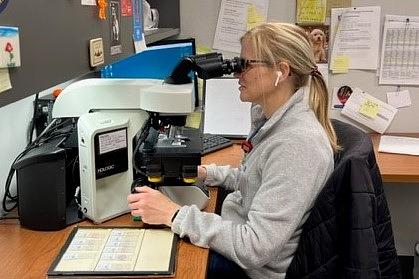
Cytotechnologists are lab professionals who study cells and cellular anomalies. Working closely with a pathologist, they evaluate cell samples and look for the sometimes subtle signs of cancerous or precancerous lesions, infectious agents and inflammatory processes; this allows them to detect serious diseases when they’re still at a treatable stage.
Cytotechnologists will also perform molecular and immunologic testing that facilitates personalized patient care. For a largely unsung profession, cytotechnology saves an astounding number of lives.
National Cytology (or Cytotechnology) Day falls on May 13, the birthday of Dr. George Papanicolaou, who invented the eponymous "Pap" smear in 1928 while doing research for Cornell University Medical College’s Anatomy Department. His discovery revolutionized both cytopathology and cytotechnology.
The Cytology Department at the Kaleida Health Laboratories employs nine cytologists (at the Center for Laboratory Medicine on Flint Road) and two cytopathologists (located at ECMC). Combined, our cytologists have nearly two centuries worth of experience in the field.
They conduct microscopic screening for tumor cells and other findings in cytology specimens received for Cytology. They process and screen GYN specimens (Paps) and NGYN specimens, including: urines, body fluids, bronchials, gastric specimens, thyroid and specimens from ROSE, EBUS and FNA procedures (in addition to many other body sites) sent to Cytology for morphologic evaluation. The team handles about 33,000 GYN cases and 5,200 NONGYN cases annually.
Please join us in thanking our cytotechnology team for their detective work in uncovering precancerous and cancerous conditions. There's a good chance the life of someone you know was saved thanks to their expertise.