
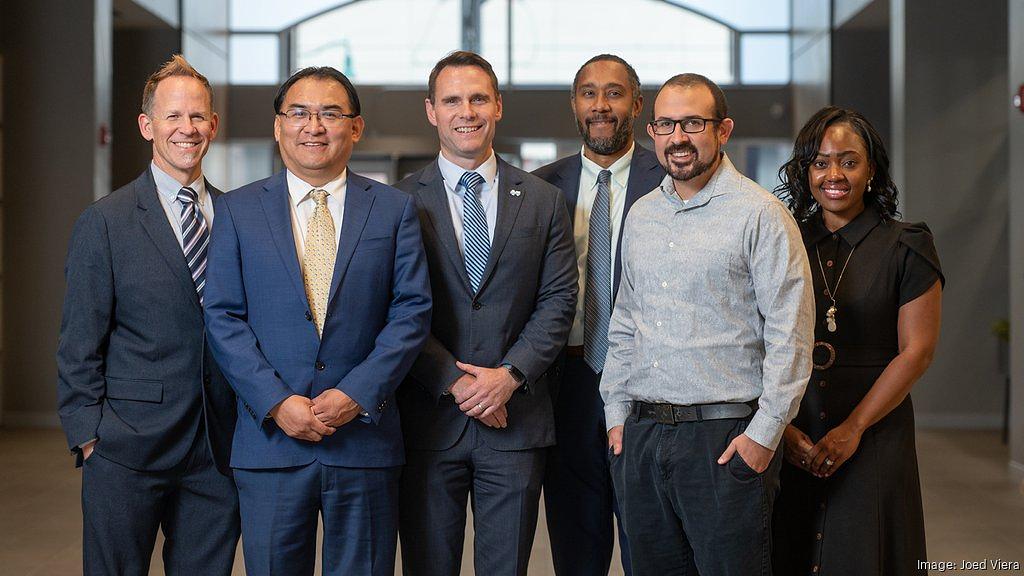
During Business First’s Table of Experts discussion, Diagnosing Disparity in Health Care, six Buffalo executives discussed how we can do better as a community. Here is a report from the discussion that was held on Sept. 26, 2023.
Simply put, most people want to live longer, not shorter, Dr. Hans Cassagnol, chief medical officer at Catholic Health, said.
But that desire can go only so far.
“What can have an overriding impact on someone’s health is the context in which they are born, including socioeconomic status and access to health services, education, food and water,” he said.
The issues around these, the social determinants of health, are what brought Cassagnol and five Buffalo-area health leaders together to sort out how to make improvements so that all patients have a better chance to live that longer life.
“In Buffalo, some of these things are more pronounced that others,” he said.
Buffalo Business First Publisher John Tebeau moderated the discussion. Joining Cassagnol around the table were:
- Michael Ball, vice president, community affairs, Highmark Western New York.
- Kevin Bidtah, chief information officer, Evergreen Health.
- Dr. Christopher Biondolillo, senior medical director, Neighborhood Health Center.
- Shannon Bryant, chief diversity and inclusion officer, Kaleida Health.
- Brett Lawton, CEO, Universal Primary Care, Health Foundation of Western & Central New York partner.
Social determinants defined
Ball added to Cassagnol’s definition saying that social determinants of health are the non-medical influences that contribute to 80% of what makes someone healthy. They include where a person was born and lives, works and plays. Also contributing are a person’s level of education, accessible transportation, healthy food, a safe and secure living arrangement and access to high-quality health care, he said.
The panelists agreed that as a result of the pandemic, the May 14th shooting, and the December blizzard, more acute needs have surfaced in the Buffalo community. Health organizations should become more intentional and work together to address those needs.
“If it’s a systemic issue we have to work as a system,” Bidtah said. “We have to work together, across the city with different providers, partners and community-based organizations to address this in a meaningful way, to see some kind of change.”
Biondolillo agreed.
It is health care practitioners’ job is to connect the dots and show both patients and the community how those social determinants result in individual health care outcomes, he said.
“I tell a patient you can’t change your genetics. If there is heart disease in your family, it’s something you were born into, but you can take some control by getting more exercise and eating well,” he said.
“But, if the patient is in an area that doesn’t have food, doesn’t have the education to read a nutrition label and doesn’t have facilities like a well-lit park to give you the opportunity to get exercise and work on those things — without addressing the social determinants of health we’re all going to hit that wall.”
Addressing the disparities
One of the ways to get at the disparities of health is to put the topic in everyone’s newsfeed, in the media, in the schools. Get eyes on it, Biondolillo said, get everyone to understand how the disparities affect them and their neighbors, that’s when changes are made.
There is another way: Vote.
“Patients are voters and can help drive change in their communities,” Biondolillo said.
So can the governing bodies and industry organizations that ensure health care providers, such as hospitals, reach certain standards including improving disparities in their communities, Bryant said.
The Centers for Medicare & Medicaid Services and the American Hospital Association are among the oversight agencies and organizations that are requiring health care systems to pay more attention to social determinants of health and are incentivizing them to do so, she said.
The very morning of the panel discussion, Bryant said, she and her Kaleida colleagues were in a meeting with regulators specifically about the social determinants of health, how the health system is doing, how will it wrap the year and what are the expectations for 2024.
“Some of it is incentivizing us to address health equities the same way we would any other strategic initiative in the business field and health care field,” Bryant said. “It’s a step in the right direction, we have a long way to go with it. It is at least at that level.”
Underinvestment in a region has an impact on the population’s health, Lawton said, such as when a major employer leaves a small city such as Olean.
Disparities grow but investment in development, especially in rural areas, can stabilize the community and improve the change that people will emerge from poverty to a place where they are not worried about where their next meal is coming from and can be free to address their health, he said.
The issue should be of particular concern to the business community, Ball said.
“We know that addressing these barriers will improve health outcomes. We also know it leads to reduced cost for everyone,” Ball said, “so, that’s one reason why it’s important to the business community.”
The economic impact is nationwide, Cassagnol said.
The largest demographic of Americans is nearing 65 and above, he said, and younger individuals are getting sicker and sicker. As a result, the nation is losing the young adults who will take care of the older generation.
It’s truly an economic issue for the country, he said.
“We have an issue from an economic standpoint going forward if we don’t address it. Just do the math,” he said. “Try to actually keep people healthy, so you have enough people to take care of us. The U.S. health care system should recognize that we’re losing economic opportunity, because every single one of these individuals we don’t impact, that’s a loss of productivity for the nation.”
Strategic partnerships
The panelists’ praised their organizations for the relationships formed with others in the area in a strategy to address social determinants of health. Those partnerships have resulted in an incredible array of programs and services that met a myriad of needs, physical, mental and social.
At Evergreen, for example, the information systems department works with Every Bottom Covered Inc., a community diaper bank, to help leaders improve delivery and business overall, Bidtah said.
“We gave them a lot of information, knowledge and tools,” he said. “We helped them stand up their database system they were using to track how many diapers they were distributing. My database team went in, fixed some things, rewrote some things, provided some training and helped them get launched and up and going. All of this was done with donated hours.”
Then the team further volunteered, doing the tangible work of packing and distributing diapers. Evergreen was proud of the team’s service, but the team members were thrilled to have made an impact, taking the project from data to delivery to the people in need, Bidtah said.
In addition to its array of partnerships, The Neighborhood Health Center last year aligned with BestSelf Behavioral Health when the latter needed to physically add a new primary care provider to its West Side location, Biondolillo said.
The two organizations were able to work together to redevelop part of the space to meet state regulations and embed a full-service primary care adult medicine center and pharmacy inside their mental health center.
“It’s really going to help provide on-site access to mental health patients who may have trouble bridging the gap of their health care or maybe trouble getting to new offices,” Biondolillo said. “They are able to see their psychiatry team, their counselors, then walk down the hall and get a physical. We are able then to use our resources to connect them to specialists right down the street at our other full-service center.”
The Neighborhood Health Center most recently began working with Jericho Road Community Health Center to provide health services for the immigrants coming into Buffalo.
Partnerships are critical for Universal Primary Care and health care providers who work in rural Cattaraugus, Chautauqua and Allegany counties and in neighboring Pennsylvania, Lawton said.
Their monthly meetings include leaders from social service, business and others in the community to strategize about available resources, financial and otherwise, that can stretch across the miles between them.
One of their current initiatives is an appeal to the state to increase their reimbursement rates, which have yet to be adjusted from 1999 figures, Lawton said.
“Everyone wants money from the state, and there’s just not enough to go around,” he said. “We’re just trying to see some equity change for health centers because our costs have just doubled. We are trying to keep up with wages and be competitive in the health care workplace. We just can’t do that with the same amount of money we got in 1999. The different rate you have to pay a provider to come there is a big challenge.”
The imperative to do so is evident in the wait to see some providers.
“To get a dental appointment for someone on Medicaid in our area, the waiting list is eight months,” Lawton said. “That’s a huge, huge shortage. About 50% of the urgent care and emergency room visits of our patients in our local hospitals are because people are trying to attend to a dental need.”
In a special dental clinic in Olean recently, patients started lining up at midnight and when the clinic opened, 340 people were waiting for access to dental care, he said. There’s a backlog of people waiting for behavioral health services as well, Lawton said.
Signs of progress
On the micro level, Evergreen Health centers moved from paper records to electronic, a move that helped leaders identify issues, particularly social determinants of health, and make program decisions strategically and faster, Bidtah said.
Conversations such as this one is an indication overall that social determinants of health and the inherent disparities are coming into the public’s consciousness, he said. There is budding realization of the enormity of the issues. The key is to have the right people engaged in the conversations, he said.
“Seeing a lot of the gaps and the need for systems and process and clarity, even some shared understanding in what we’re talking about, is very helpful,” Bidtah said. “Those are small things that are successes. We’re actually talking about the same things. Now, let’s look and see if we can make things better than they were before.”
Payers and regulatory agencies and others have long collected data on health outcomes by the nation’s providers, and they’re only expanding on these efforts into the future.
Health systems next year will be incentivized through a federal program to assess patients for the social determinants of health and have a place to collect that data, Bryant said.
To that end, Kaleida is going to include an assessment feature in their electronic medical records to collect data. Beyond that, Kaleida will ensure its network of service providers and others are in place so patients can be referred.
It would be irresponsible of Kaleida to have an assessment like this and then not have a referral mechanism to close the loop, Bryant said.
Looking ahead
Deciding where to make the biggest improvements is difficult because everything needs to get done, Bryant said.
Kaleida built its employee equity dashboard in 2022 and has been utilizing it to set goals around improvement in diversity, equity and inclusion and how its workforce matches the community served.
“This year we are focusing on making sure our health equity dashboard was also able to tell us a story on how we are doing on the patient side of things,” Bryant said.
To that end the health system is continuing its focus on birth equity in concert with the New York State Birth Equity Project and will add cardiovascular health issues, Bryant said.
Everyone should be paying attention to artificial intelligence and the divide that that brings, she said.
“It’s great that we’re going to have more technology and more things available to our patients to use,” she said, “but we have to be very thoughtful about bringing in new technology and relying on new technology to support these health equity initiatives. We have to be aware that there is a digital divide.”
Cassagnol emphasized the importance of payers and patients joining providers in pressuring leaders in Washington for policy changes for the improvement of issues around the disparities in the social determinants of health.
“Each of us is going to be able to make significant change in our own population but really to change the entire population of our country, we need some significant policy change to address that,” he said.
Panelists
Michael Ball, vice president, community affairs, Highmark Blue Cross Blue Shield of Western New York. Michael Ball is vice president, community affairs for Highmark Blue Cross Blue Shield of Western New York, where he oversees the company’s support of corporate grants, sponsorships, and community programs, services and initiatives aimed at addressing health disparities throughout the community. Ball also leads all elements of the health plan’s Blue Fund, which awards major grants to local organizations and initiatives that enhance the health of the region.
Ball joined the health plan from Empire State Development (ESD), New York’s chief economic development agency, where he most recently served as regional director. He also served as executive director of the Western New York Regional Economic Development Council and was charged with strategic planning and local implementation of the state’s annual funding competition.
Prior to joining ESD, Ball served as director of planning and implementation and director of Healthy Communities Initiative for Buffalo Niagara Medical Campus, Inc., a consortium of the region’s health care, life sciences research, and medical education institutions co-located in downtown Buffalo. Ball received a master’s degree in urban planning and certificate of specialization in economic development planning from the University at Buffalo, and a bachelor’s degree in political science and urban studies from Canisius College. Ball is a native and resident of Buffalo, New York. He serves on the board of trustees for Buffalo Olmsted Parks Conservancy, board of directors for Buffalo Sabres Foundation, and alumni board of governors for Canisius High School.
Kevin Bidtah, chief information officer, Evergreen Health. As chief information officer of Evergreen Health, Bidtah is responsible for overseeing the use of information systems to support the organization’s strategic goals and vision. Bidtah provides leadership of the long-term vision and direction of all technology, telecommunications, and data systems, and ensures the protection and security of all electronic health information for Evergreen’s patients. Under his leadership, Evergreen completed a successful conversion from paper to electronic data systems, implemented a data governance program and launched its first dashboard analytics environment. He is an active member of the College of Health Information Management Executives (CHIME), Health Information and Management Systems Society (HIMSS), and the American College of Healthcare Executives (ACHE). He serves as a volunteer board member for a few local organizations, including CCNY, Inc and Southtowns Stars Amateur Hockey Association. In 2018, his team received a SOPHi (Spotlight on Population Health) Award in the Data Driven Organization category. In 2017, he was named a Buffalo Business First Health Care Champion. Bidtah has a bachelor’s degree in psychology and French from the University at Buffalo. He has achieved the Certified Healthcare CIO (CHCIO) certification through CHIME.
Dr. Christopher Biondolillo, senior medical director, Neighborhood Health Center of WNY. Dr. Christopher Biondolillo was born and raised in Hamburg, New York, where he currently resides. He obtained his undergraduate and medical education at SUNY Buffalo, and then proceeded to complete a residency in Family Medicine at East Jefferson General Hospital in Metairie, LA. Biondolillo came home to Western New York and joined Neighborhood Health Center of WNY in 2015 where he uses a Trauma-Informed Resilience-Oriented framework for caring for patients in Neighborhood’s family medicine department. He currently serves as Neighborhood Health Center’s senior medical director where his focus is on clinical quality, patient experience and provider resilience. He loves his family and the Buffalo Bills.
Shannon D. Bryant, LMHC, chief diversity and inclusion officer, Kaleida Heath. Bryant is the chief diversity and inclusion officer at Kaleida Health, a not-for-profit healthcare network which includes more than 10,000 employees and nearly 1,700 medical providers. Bryant is known for developing strategies that lead to transformative cultures, operational excellence, and enhanced community partnerships.
A talented speaker, trusted advisor and coach. Bryant successfully navigated leadership roles, organizational transformations, health equity initiatives, and leadership development programs in healthcare non-profits and private sectors. Throughout her career she created and served in inaugural roles to meet growing organizational needs. Bryant integrates healthcare operations, leadership coaching, and people change strategies to yield measurable outcomes for staff and patients alike. Bryant is an award-winning and highly sought after healthcare executive, community leader, and speaker. She is passionate about connecting with people, organizational management, and prioritizing equity. Bryant is married to Rickey Bryant Jr. They have two children Solomon Harvey (8) and Maxwell Judith (6). The Bryant family resides in North Buffalo with their dogs, Randolph and Maeve.
Dr. Hans P. Cassagnol, MMM, FACOG, CPE, executive vice president, chief clinical officer and chief physician executive, Catholic Health. Hans P. Cassagnol, MMM, joined CHS in March 2019 as chief physician executive. With a medical career highlighted by achievements in quality and innovation, Cassagnol joined SUNY Upstate Medical University in Syracuse, New York, in 2015, most recently serving as vice president of quality/chief quality officer. Prior to that, he served as associate chief quality officer at Geisinger Health System. Cassagnol joined Geisinger in 2002, holding several clinical, administrative and academic positions, including associate chief quality officer and director of obstetrics & gynecology. Cassagnol received a Master of Medical Management Degree from the University of Southern California. He received medical degree from the University of Connecticut, School of Medicine and completed his residency in obstetrics and gynecology at Flushing Hospital Medical Center.
Brett Lawton, CEO, Universal Primary Care. Brett Lawton is the chief executive officer of the Southern Tier Community Health Center Network d/b/a Universal Primary Care (UPC). UPC provides primary medical care services to Cattaraugus and Allegany counties in New York and McKean County in Pennsylvania, at five offices throughout the area. UPC is designated a Federally Qualified Health Center serving over 14,000 patients 2023. Brett leads 130 employees at Universal Primary Care, manages a budget of around $14 million, and is responsible for maximizing reimbursement, assessing and meeting community needs, adhering to federal and state regulations and building community partnerships. Brett works with the patient-lead board of directors to develop and implement the strategic plan. He is passionate about the Health Center movement and thinks it is brilliant public policy. Brett has a master’s degree in public administration and has been involved in the health center movement for the past 15 years. Participation made possible by Health Foundation for Western & Central New York.