
It’s been about 14 years since the region’s largest hospitals began using da Vinci robotic surgical systems for urological and OB-GYN procedures.
Today, these systems are being used in just about every specialty, including thoracic, orthopedics and general surgery, giving even smaller community hospitals the opportunity to offer minimally invasive procedures with quicker recovery times.
Millard Fillmore Suburban Hospital is taking full advantage, with five robots and a surgical case volume and breadth of services that rivals the top programs, according to hospital officials. The hospital is on pace to complete its 20,000th robotic-assisted surgery and does about 2,500 annually.
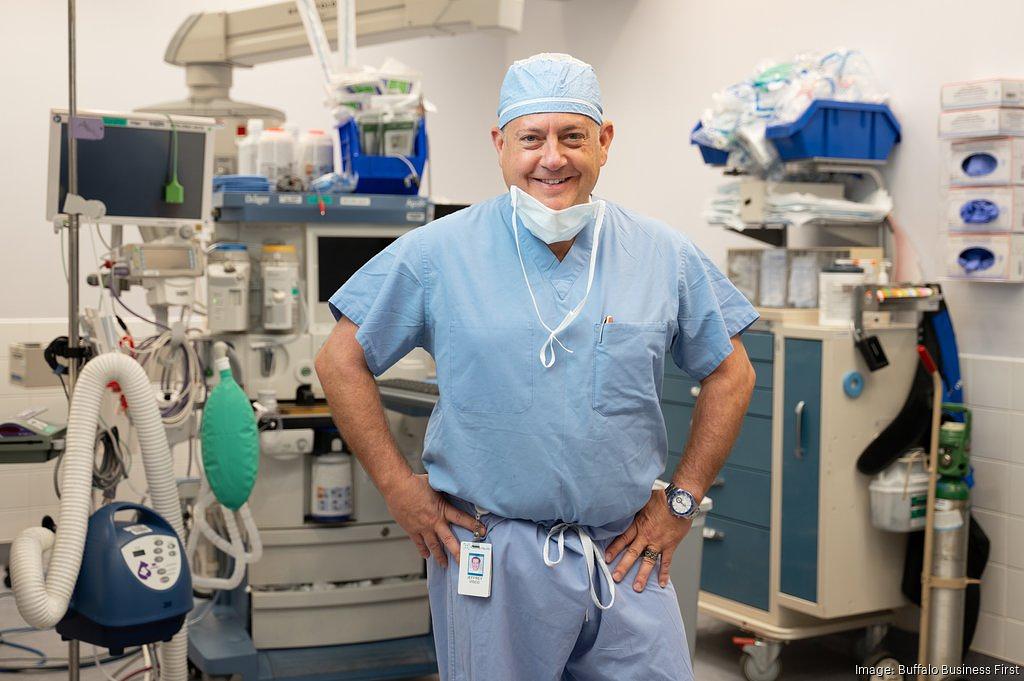
“We’ve been growing exponentially,” said Dr. Jeffrey Visco, director of surgical services. “For a small hospital like Suburban, we replicate the growth and also the volume of some of the major university hospitals across the country.”
The hospital is the only one in Western New York certified as a Robotic Center of Excellence, which Visco said is bolstered by a unique collaborative approach by multi-disciplinary teams that work together during surgeries.
The technology is getting more precise, offering innovative approaches to surgery that haven’t previously been possible.
“We’re getting into places we couldn’t even dream of – and not spilling a drop of blood,” he said. “What we’re able to do for cancer, the optics are 10 times what your normal sight can see and the robot corrects for any tremor.”
The next iteration of the system will incorporate tactile feedback and touch, as well as combining MRI and CT scan capabilities and new dyes to allow tumors to be cut out with laser accuracy, he said.
“We’ve been on the forefront since the beginning, but the stuff that’s coming out is exciting,” Visco said.
Buffalo born and raised by a cardiologist father, Visco earned a bachelor’s at Cornell University, then returned to Buffalo for medical school and a general surgery residency and colorectal specialty training. He started his career in private practice with Buffalo Medical Group before joining Kaleida Health and UBMD Surgery, where he is UB’s assistant program director for the colon and rectal fellowship.
The field of robotics will continue to add new technologies that will give surgeons the ability to see smaller items, not visible to the naked eye.
At the same time, robotic arms are getting smaller and making even tinier incisions. Visco said one system he's seen has a single metal tube that makes just one incision to deliver a device that opens into five arms once inside the body.
“It’s truly amazing,” he said. “Different companies are just raising the scale and the bar every day in terms of what we’re able to deliver to our patients with minimally invasive work. It’s a really exciting time in surgery.”