
No one with cancer ever wants to hear their physician say that treatments aren’t working and that all efforts have been exhausted.
A series of new and ongoing clinical trials in the Buffalo region is offering new hope for those patients, while simultaneously bringing in millions of research dollars.
Health care leaders prefer to focus on the goal of their work: identifying and developing new therapeutic treatments to diagnose or treat cancer, as well as lessening the impact on individuals fighting the disease. But the fact remains that those efforts also help to grow the local workforce and support the local economy.
While Roswell Park Comprehensive Cancer Center remains the region’s leader, research and clinical trials are also underway at the University at Buffalo and its partners at Kaleida Health and Erie County Medical Center, which together make up Great Lakes Cancer Care Collaborative.
Roswell Park has 193 active cancer-related clinical trials underway, with more than 40 set to open in the next six months. That includes trials from homegrown research, as well as instances where Roswell Park serves as a trial site for other research centers.
Research grants of nearly $80 million annually support clinical research and trials for new therapies and approaches for about 1,000 patients each year at the Buffalo hospital, plus jobs for hundreds of health care workers, researchers and support staff.
Clinical trials are vital for cancer patients, providing access to new therapies in a controlled setting while finding new treatments that other patients will benefit from in the future, said Dr. Anuradha Krishnamurthy, associate director of early phase clinical trials for solid tumor cell therapies at Roswell Park.
An assistant professor of oncology and medical oncologist focused on gastroenterology oncology, including colorectal and pancreatic cancer, she’s especially excited about a clinical trial to develop a Car T Cell immunotherapy to target aggressive forms of pancreatic cancer.
“When FDA-approved therapies have been exhausted, that’s when clinical trials come in and provide another avenue,” Krishnamurthy said.
If their situation is appropriate, she explained, patients may have access to four phases of clinical trials:
- Phase 1: New drugs are evaluated in a small group of people at various dose levels to determine drug toxicity and which is best tolerated.
- Phase 2: The drug is tested in a slightly larger group of patients to see if there is promising anti-cancer activity.
- Phase 3: The drug is tested in an even larger group and compared to existing therapies for a particular type of cancer. If it delivers better, more effective results than what’s currently available, it may receive FDA approval.
- Phase 4: In post-approval, the drug is then tested for side effects in a larger group and assessed for better outcomes.
Very, very few make it to the approval phase, with maybe 10% making it to Phase 1, and only 10% of those to Phase 2 and so on, which is why thousands of drug candidates are tested every year, she said.
“We have to go through a lot of drugs to evaluate to find something that eventually works, but hopefully, those numbers are getting better – especially with new immunotherapies,” Krishnamurthy said. “I think you learn something from every trial that you do and every drug you see go through trials. … Everything we learn is reused in a different way and provides the next piece of information we need to develop the next drug.”
Troubles in getting to trials
Getting those clinical trials completed isn’t easy, however. Dr. Ravindra Pandey has been working on a trial through Photolitec LLC, the company he founded based on light therapy research developed at Roswell Park for recurrent glioblastoma, a type of brain cancer.
Though the company received approved for a Phase 1 trial and a $2.2 million federal grant in 2020, it took another two years to get the clinical protocol approved by the institutional review board. Pandey has yet to identify even one of the 15 patients he’ll need. That’s because the patient must first exhaust other chemotherapy and radiation options, and most patient don’t live long enough to try the company’s Photobac photodynamic therapy, which has been granted orphan drug status because of the rarity of glioblastoma.
“To get these patients for the trial has been an issue,” he said. “There’s a limited number of patients and we’re not getting enough.”
Funded in part by a grant from the National Cancer Institute within the National Institutes of Health, Photolitec has received a commitment from an Indian company to fund the second phase of trials.
“It’s been a tough go,” Pandey said. “We worked so hard getting to this phase, but that is a big problem for small biotech companies to get money and investors. … It’s a risky business.”
Even though dozens and dozens of clinical trials exist in the region, that doesn’t mean a thing if patients don’t know about them or how to access them. Lack of awareness or misconceptions about clinical trials are a major impediment to a trial’s potential success, said Tricia Barrett, CEO at Crowley Webb & Associates and Praxis Communications LLC, a wholly owned subsidiary that provides patient recruitment services for clinical trials.
“People know that research is being done and conducted here, but actually being able to participate in a clinical trial is more challenging, I think, than ever before,” she said, pointing to National Institute of Health statistics that 85% of cancer patients are unaware they can participate in clinical trials. “A lot of it goes to the complexity of the trials themselves. There’s inclusion and exclusion for each trial and for a patient to meet the eligibility requirements can be a challenge.”
And for researchers, there’s a bigger problem: While getting into a trial can be challenging, retaining patients in the trial can be even tougher, due to time commitments and geographic location. And if the study has a placebo arm, some people opt not to participate at all.
“The dropout rate can be fairly high,” Barrett said. “I don’t think that we do a good enough job educating patients about what to expect by participating.”
Building a program
The University at Buffalo and Great Lakes Cancer Care have been building a research portfolio of their own. UB has $22 million in cancer-related research expenditures — including $1 million tied to clinical trials – coming from the National Cancer Institute, the Department of Defense and other federal funders.
That figure is expected to grow, said Dr. Allison Brashear, UB vice president for health sciences and dean of the Jacobs School of Medicine and Biomedical Sciences.
“UB’s entry into the area of clinical trials in cancer is relatively recent and we expect our clinical research funding to grow over time as it has been identified as priority in our new strategic plan,” she said. “We place great value on collaboration with our clinical partners in order to provide Western New Yorkers with the very best care and treatment and will continue to advance our research footprint for the betterment of our community.”
That includes a cancer research consortium established three years ago to coordinate cancer research across UB’s 20 departments, where more than 60 investigators bring in grant funding for their work in seven schools, including medicine, dental, pharmacy, engineering and public health.
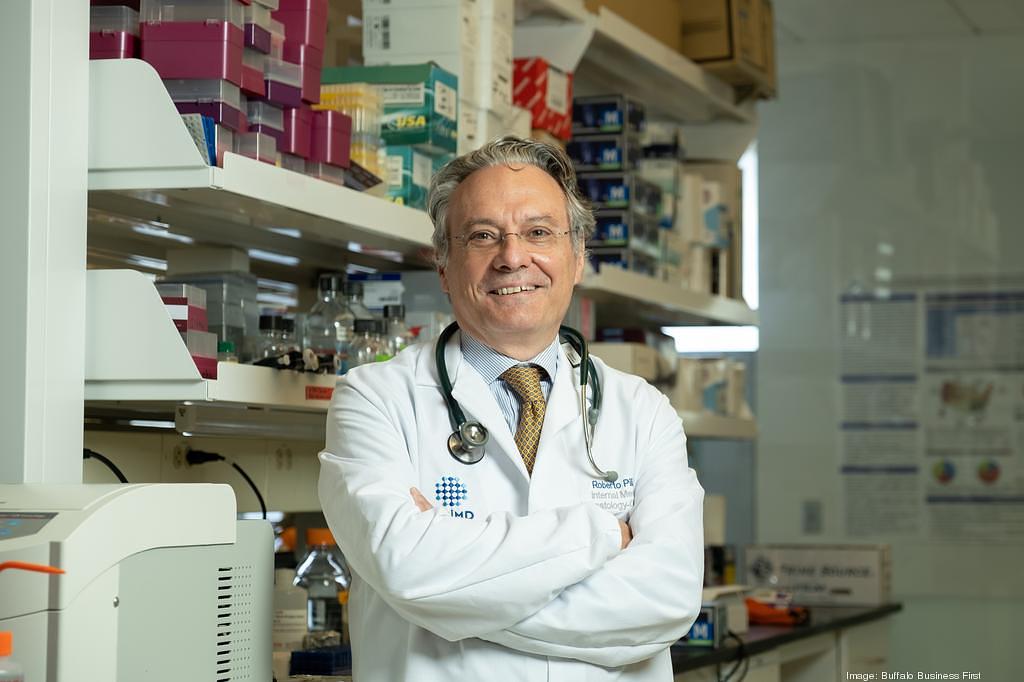
Dr. Roberto Pili, who joined UB three years ago, leads those efforts as associate dean for cancer research, professor of medicine and chief of the division of oncology. He also serves as vice president for oncology services with partner Great Lakes Cancer Care.
“It’s a sizable amount of money, and goal now is to try to provide a clinical trial platform for scientists at UB that can really develop new experimental studies,” he said. “We envision we’re going to have more clinical trials to come.”
The dollars coming in now should help seed research that will attract additional grants from both government and pharmaceutical industry funders, Pili said.
Pili, who previously led the genitourinary cancer program at Roswell Park, has spent the past 20 years focused on nutrition and its relationship to cancer. At UB, he leads the Sciences, Nutrition and Cancer Center, where he explores how changes in diet can affect clinical outcomes for patients receiving chemotherapy. He has two studies underway in the pre-clinical or feasibility phase open to any patient receiving chemo. Already, he’s had 30 patients join the study from both Roswell Park and Great Lakes Cancer Care.
“Our clinical research program is fairly new but growing and expanding,” he said. “We’ve just started hiring dieticians dedicated to these studies, but eventually will need quite a few staff.”
Opening access to all
Erie County Medical Center, a member of Great Lakes Cancer Care, has also been expanding its research base, which is leading to more clinical trials. That effort got a kick-start 10 years ago with the launch of the hospital’s head and neck cancer program.
The program has grown in recent years, with several pre-clinical, supportive and active clinical trials now underway tied to newly diagnosed head and neck cancers as well as therapeutic trials for advanced stage cancers. Last year marked the first time ECMC was selected as a prime clinical trials site when dental oncologist Dr. Jennifer Frustino was funded by the National Institute of Health for $900,368 through the National Institute of Dental & Craniofacial Research.
ECMC’s Center for Oncology Care is actively enrolling participants on multiple sponsored clinical trials and investigator-initiated studies, as well as supportive trials to help reduce the side effects of cancer treatment.
That’s significant, because ECMC offers access to trials for a different population of patients than those might pursue care at other hospitals in town – or even outside the region, said Frustino, director of oncology research, who oversees cancer-related clinical trials as well as investigator-initiated trials and other corporate grant-funded research from companies including Merck.
“We’re unique in our location and the demographic of cancer patients that we serve,” she said. “As a Level 1 trauma and safety net hospital, we have an under-served demographic that wouldn’t otherwise probably have the opportunity to be a part of these trials we are providing and these studies.”