
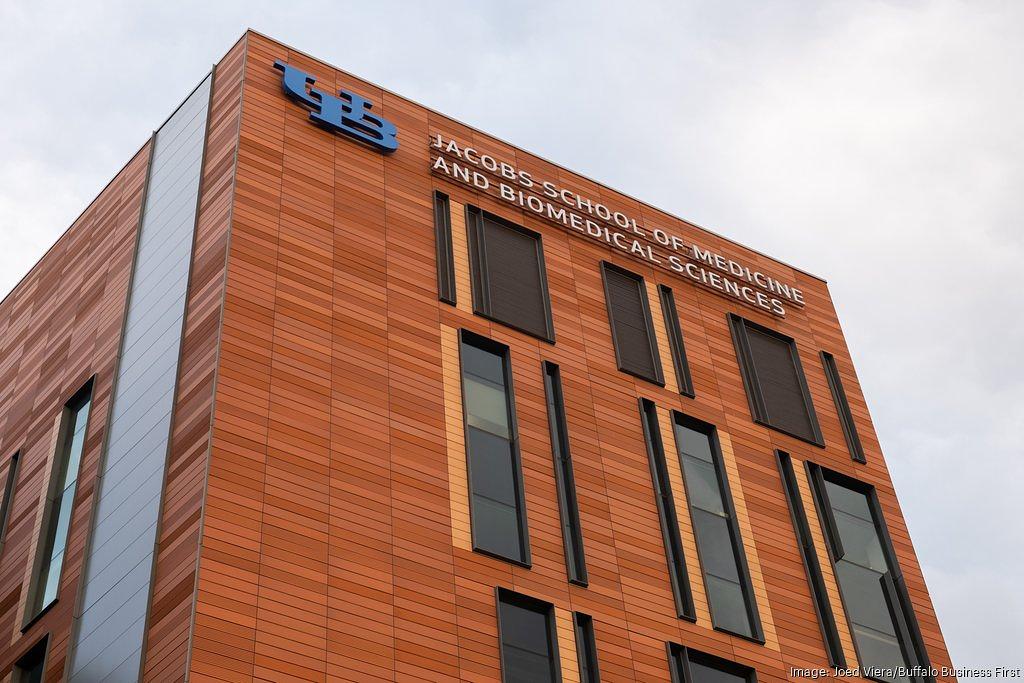
Though the soaring use of telemedicine may sound old hat now, that seemed far off and improbable when both were predicted in a “Future of Medicine” report by the Jacobs Institute published five years ago.
How about using artificial intelligence and virtual reality to train the workforce? Self-diagnosis with the help of wearable smart devices? Bionic prosthetics?
Those new technologies and more are predicted in a new Future of Medicine report published this month by the University at Buffalo’s Jacobs School of Medicine & Biomedical Sciences in tandem with the Jacobs Institute.
“I do not see technology supplanting the doctor-patient relationship, but what all this is driving toward is being more effective in patient care,” said Dr. Allison Brashear, vice president for health sciences at UB, dean of the medical school and a member of the team that developing the report.
The report will be detailed at a 3 p.m. panel discussion Nov. 29 at the Jacobs School that includes physician leaders as well as community members and futurists who edited the report.
Dr. Adnan Siddiqui, CEO and chief medical officer at the Jacobs Institute, pointed to the report as a forum for futurists, doctors, engineers and innovators to come together and predict what they see happening over the next five to 10 years in health care.
The report points to increasing demand for health care services amid a shrinking supply of practitioners and a changing workforce and new options for patient portals, apps and care sites.
That coincides with more tools to promote aging such as gene editing, stem cell therapy and phenomics – an outgrowth of genomics and personalized medicine. Brashear said physicians, and the institutions that train them, will need to adapt and adjust to meet changing needs and realities as demand grows and supply shrinks.
“Technology and innovation are driving health care, whether that’s new devices, using artificial intelligence or machine learning, but also focusing significantly on taking care of a diverse population in new and different ways,” she said. “That includes wearables at home, making sure what people get is more comprehensive in the home, and using all the technologies to really keep people healthy.”
The report also targets ongoing changes to care settings, continuing a trend predicted in the last report. For example, Brashear said, look at the expanded capabilities at pharmacies for vaccines, which was rare pre-pandemic.
Other chapters focus on challenges to health care tied to climate change, including training medical residents on climate-related diseases as well as reducing the carbon footprint of the medical industry; emerging neuroscience research tied to mental illness and brain health; as well as what the exploding growth in wellness will mean for medical tourism and genetic testing.
On the health education side, medical students are already learning how to use new technologies, but they’re also learning about social determinants of health, how to keep care patient-centered and the best way to use technology to provide that care.
“Students are going to have to understand health economics and how those care models impact the way their patients are cared for,” she said. “What is heartening about the report is it is really setting the stage for how health care is really becoming so integral to everything we do in our world.”