
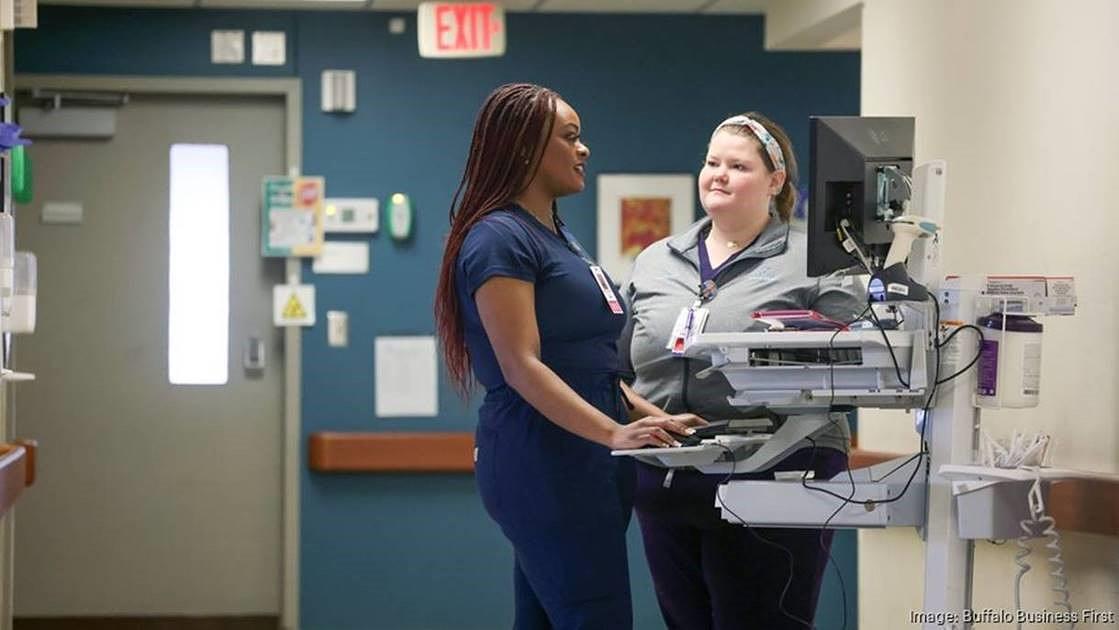
Nurse Jena Mattina-Chmiel, right, works with new nurse Marie-Airelle Kemembin at Buffalo General Medical Center in Buffalo
Mark Mulville
By Tracey Drury – Senior Reporter, Buffalo Business First
Jan 23, 2025
Kamala Ghatane had been working for several years in Roswell Park Comprehensive Cancer Center's environmental services department when she realized she wanted more.
The Nepal native had worked as a nurse in her home country, but lacked the education and skills she needed for licensure here in the U.S. She found opportunities within the Buffalo hospital to help her get certified as a patient care technician. Then she worked with her nurse manager to become licensed as a registered nurse.
Seven months ago, she transitioned into the hospital's inpatient nursing care team.
Ghatane is among hundreds of new clinical workers hired or developed within Buffalo hospitals who are helping to fill a major staffing gap. The exodus of thousands of health care workers from the industry during and immediately following the pandemic left area hospitals with the challenge of making the profession attractive enough to not only draw new staffers, but keep the ones they had.
Kamala Ghatane, a Nepal native, joined Roswell Park Comprehensive Cancer Center's environmental services department in 2020, then got certified as a patient care technician and became a licensed RN.Roswell Park Comprehensive Cancer Center
It’s a well-documented problem shared by hospitals and health systems of all sizes, both nationally and in Western New York. Here more than 1,500 full-time equivalent (FTE) workers left their jobs through 2022, forcing hospitals to spend millions on temporary and agency workers, especially nurses.
Industry executives say they’re making strides to rebuild that workforce:
- Catholic Health hired 605 nurses last year, bringing its total nursing staff up to 2,195. They were among 2,672 new hires across the system in 2024, bringing total employment to 9,458.
- Erie County Medical Center has grown its workforce to 4,127 employees, including 770 new hires last year. That includes 344 nurses —181 RNs, 72 LPNs and 91 certified nursing assistants.
- Kaleida hired 2,553 staffers last year, bringing total employment to 11,292. That includes 449 net new nurses since 2022, plus 243 assistive personnel working in positions such as medical assistants or nurse’s aides, with 67 net new certified nurse assistants.
- Roswell Park Comprehensive Cancer Center hired 76 nurses in 2024, bringing its total workforce up to 4,278 full- and part-time employees.
That pace will need to continue to overcome ongoing shortages nationwide: The Health Resources and Services Administration is projecting a lack of 78,610 full-time RNs in 2025 and 63,720 in 2030. And according to employment projections through 2032 by the Bureau of Labor Statistics, although the registered nursing workforce is expected to add 177,440 nurses, growing by 6% to 3.3 million, the industry is projected to see 193,100 openings annually when retirements and workforce exits are factored in.
Residency, apprenticeship programs
Ongoing training for new nurses is a strategy that's shown results. Catholic Health launched an internal nurse residency program in fall 2023 for graduate nurses as they transition from students to full practitioners in emergency care, intensive care, mother/baby care and medical/surgical services. Accredited by the American Nurses Association, the program offers a fully paid residency program with classroom instruction, simulation labs and hospital-based clinical settings.
The residency program started in 2023 with nurses in specialty units then expanded last year to other units. All new graduate nurses work with on-site educators to learn the skills they need, completing the program in six months to a year.
“The whole goal is to prepare them to transition into practice,” said Theresa Hurd, vice president of clinical education, research and professional practice, who helped to design the program. “They’re graduated from college as registered nurses but have never practiced as a nurse. That first year is where we lose so many nurses, so because of that, we wanted to develop a program that would support them, teach them, work with them and build excellence in nurses.”
Nurses in Catholic Health's nurse residency program participate in a summer simulation skills program taught by Kevin Buck, with Emily Jerge serving as the patient.
Catholic Health
It’s already making a difference: Among the 189 new nurse graduates that started in 2024, 95% have been retained. That’s compared to a nationwide average of about 70% for first-year graduates, Hurd said.
“People think the No. 1 reason nurses leave the profession is money, but it’s their work environment,” she said. “They don’t feel confident, they feel scared. We invest in them, we invest a lot of time.”
Improving culture to make work feel like home
Hiring efforts are less effective, however, if workers don’t want to be there. That’s why improving culture of work is so important, Kaleida Health CEO Don Boyd said.
That begins with really connecting and engaging with frontline staffers across the $2.5 billion system. Listening is just part of the culture building process, he said, which also includes accountability when errors occur and recognizing individuals in different ways for their contributions.
Nurse Jena Mattina-Chmiel, left, works with new nurse Marie-Airelle Kemembin at Buffalo General Medical Center in Buffalo
Mark Mulville
“We did a lot of work to create a movement where people want to come to work, where they see a pathway for them to continually grow and develop,” he said. “If you support them with resources – financial and otherwise – that’s a place we think they’ll want to stay and be part of.”
Building relationships between new and existing workers is key, said Charlene Ludlow, senior vice president of nursing at ECMC, which offers an internship program for nurses in their senior year to get more hands-on experience and bedside opportunities to work with preceptors for extra training. ECMC preceptors also work with nursing students on their capstone projects.
“We’re creating relationships,” Ludlow said. “Many have given us feedback that being part of the team has really helped them understand what their role will be and that as they graduate, they will be part of a team, they won’t be on their own... It’s definitely a little change of culture from days of old.”
Growing talent in-house
Roswell leaders said its focus on cancer has helped the hospital limit the recruitment struggles many of its peers have faced.
With 4,278 full- and part-time employees or 3,947 FTE, the $1.3 billion Buffalo-based hospital’s annual turnover rate is 7 percentage points lower than the national average for nurses, said Corrine Latini, director of talent acquisition. Last year, the system hired 76 new nurses.
Still, with 340 open positions systemwide, the talent acquisition department remains active at job fairs and through collaborations with community groups to keep new candidates coming in the doors. It also offers skills training opportunities internally to boost retention and identify internal opportunities to grow.
Roswell also offers trainee-ships for internal staff that allow people with little to no experience, education or degree to be trained in-house to find new career paths.
“We’re thinking more before the vacancy, not when it comes about, and being very proactive,” Latini said. “You think of the clinical mission, but we really do have that research component and all the support posts that go along with it. We’re our own mini city… you need all those individuals to run the organization and we make sure we look at the institution, look at the career ladder.”
“It’s not always about finding people from the outside to come in, but also looking at current staff and how we can help them grow.”
ECMC works with nurses who haven’t yet earned a bachelor’s degree, offering tuition reimbursement with funding from the ECMC Foundation.
RN Allison Monaco works on paperwork at Buffalo General Medical Center in Buffalo.
Mark Mulville
Kaleida has also developed an LPN apprenticeship program in tandem with CWA and 1199SEIU’s training funds. It is the nation’s third federally registered LPN apprenticeship program. Three cohorts have completed the program, with a 100% retention rate so far. A fourth cohort of 10 will begin this spring. The program focuses on existing employs who want to take the next step into clinical care, but can’t afford to stop working to attend school.
Those internal career ladder programs are vital for retention, said Don Fiorilli, regional director for the 1199SEIU training and employment funds.
He said he's seen more health care workers looking to upskill or climb the career ladder with new credentials and degrees as more employers work to engage people in those conversations.
“The degree to which health care employers, workforce organizations and labor are partnering now is something I haven’t seen in my career,” he said, pointing to a 20-year affiliation with the union and seven years in workforce development. “I think together we will be able to not just sustain but increase interest, recruitment and retention moving forward.”
Replacing agency reliance
Reducing the need for travel nurses has been a major goal for most hospitals, largely due to the increased expense. And as demand has waned, the cost to hire those travel nurses has come down significantly: According to Vivian Health, a national health care hiring firm, the average weekly salary for a travel nurse in New York in early January was $2,359, down nearly 40% from January 2023, and more than 51% from 2022, when the weekly salary was $3,986.
Catholic Health created its own systemwide temp agency in late 2021, with hires committing to 12-week assignments at sites across its system but with the flexibility to shift to other sites based on coverage needs. Nurses in the program account for more than half of the 200 agency temps who worked at Catholic Health hospitals in early January.
Just like with outside agency nurses, the goal is to give them reasons to sign on full-time. Over the past two years, that’s happened with 56 nurses, said Julie Mungo, director of talent acquisition and retention.
“It allows them to kind of see how the system works and almost test the waters, especially if they’re local,” she said.
Kaleida went from a high of 250 agency nurses down to about 70 total across the system, including Olean General and Bradford Regional Medical Center. And though the need continues to be highest for night shift, the system saw a reduction in need that time frame as well for the first time in 2024.
“What’s really exciting is in the last six months of last year, 2024, we have seen an increasing number of agency nurses converting to employees at Kaleida Health – 25 or more that were agency,” Boyd said. “As those agency rates have come down, people are converting to full time. …That speaks to all the other work from the culture and retention side.”
Growing the pipeline
While recruitment is important, it’s been even more vital to build the pipeline of future workers. That comes from developing collaborations with area colleges and universities and community groups.
The hospitals have worked with Buffalo Center for Arts & Technology to expand its catalog of health care jobs to 11 prioritized job titles, ranging from nursing and clinical laboratory technicians to respiratory therapists and medical assistants. They also work with Say Yes Buffalo to build on existing apprenticeship and training programs in IT and administrative functions to add a health care vertical.
Catholic Health has turned to Junior Achievement, the Health Care Science Charter School, the International Institute of Buffalo and other groups for hard-to-fill positions. That includes sterile processing, OR and lab technicians and CT and imaging staff but also non-clinical roles like housekeeping, dietary, IT and finance.
“We’re creating those pipelines and letting the community know you can work in health care even if you don’t have a health care background,” Mungo said. “We’re trying to educate our youth about different opportunities within health care that are beyond being a doctor or a nurse.”
Catholic Health, ECMC, Kaleida, Roswell Park on rebuilding workforce - Buffalo Business First