
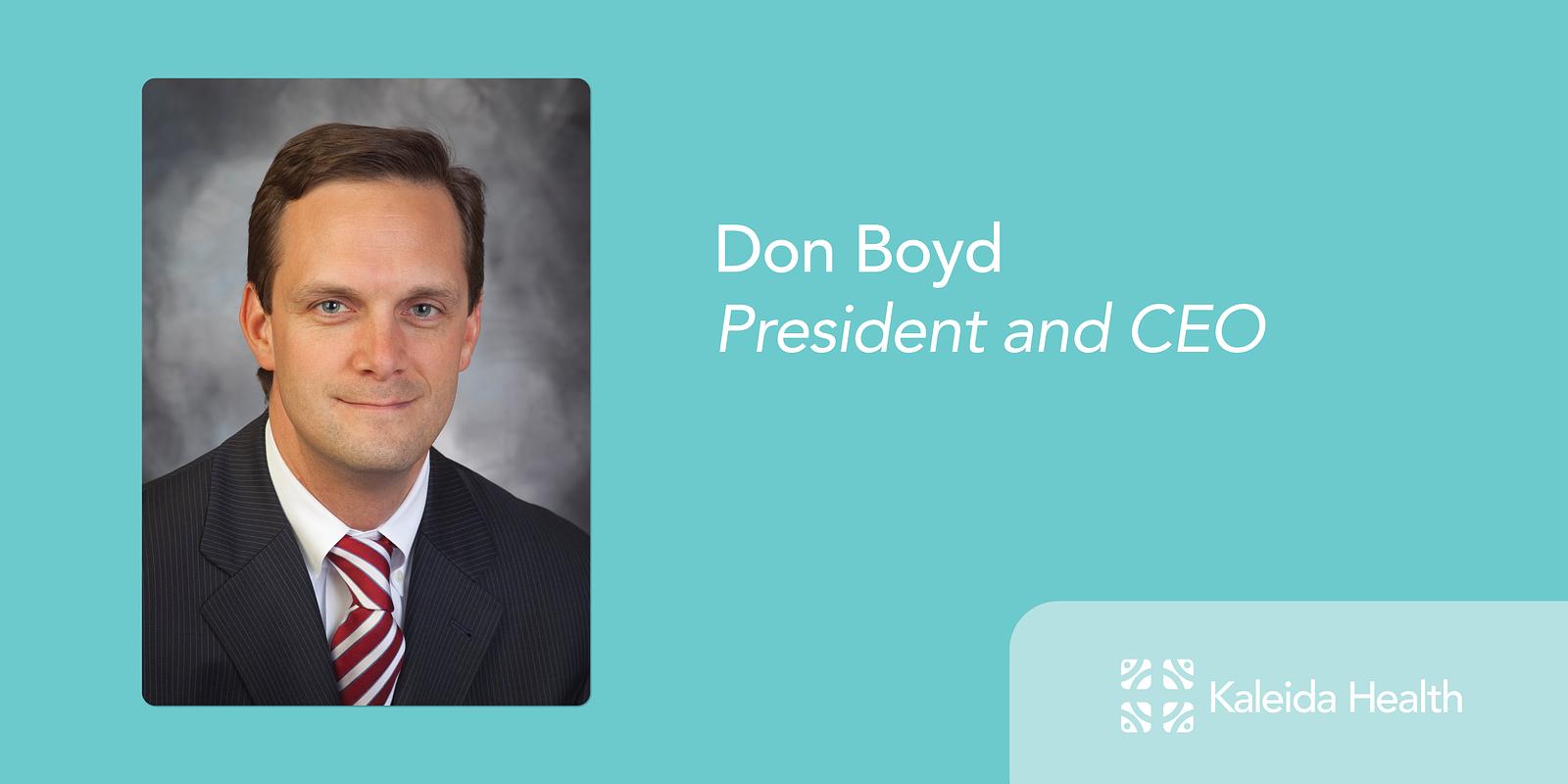
Facing a mid-year deficit topping $60 million, Kaleida Health’s new CEO said he’s busy working on ways to generate revenue and minimize losses at the region’s largest health system.
Don Boyd took on the post in mid-July, shifting from president and COO to president/CEO, in the midst of some of the $2 billion health system’s greatest challenges. Those include negotiations on a master labor agreement that covers two-thirds of its 10,000-plus employees; ongoing losses tied to diminished volumes and shifts in care away from its hospital sites; and costs tied to agency staffing that are on track to reach $97 million this year (compared to $14.5 million in 2021).
Boyd said Kaleida Health faces the same challenges as every hospital and health system in the country, working to undo the impact of Covid-19.
“We talk about post-pandemic recovery, but we’re also simultaneously planning for the potential for another increase in cases as the calendar turns,” he said.
On the finance situation, Kaleida was losing $10 million per month before June, with volume creeping back up after Covid surges in the winter. That began to improve in June, but not yet to pre-pandemic levels. The system lost $46 million in 2021, buffered by $20 million in federal relief funds that may not be available this year.
Some volume losses came from patients who went instead to surgery or outpatient sites unrelated to Kaleida after physicians found other locations due to surgery moratoriums. None of this is new to Boyd, who has spent the past 25 years with Kaleida in varying executive positions.
Kaleida hopes to recapture some of that volume, while growing in 2024 when it adds a medical office building and ambulatory surgery center in Amherst to sites already operating in East Amherst, Orchard Park, Cheektowaga and Niagara Falls.
Workforce retention and development, Boyd said, remain the greatest challenge for Kaleida at a time when many people have decided to leave the profession, whether that's for something better in the business, like a higher-paying traveling nurse job, or something outside the industry as Great Resignation opportunities abound.
“The ability to recruit people back into health care and retain people in our organization is probably one of the most significant challenges we as an industry face now,” he said. “It’s a very competitive job market, so our processes and our approach have to reflect that.”
And that was true even before Kaleida announced last month it would hire another 436 workers systemwide to meet additional staffing needs following a state-mandated staffing assessment process.
Boyd’s plan to address those issues relies in part on the state recognizing that there is more investment required to help hospitals bolster and grow their workforce. And he’s counting on payers – including state and federal governments and private health plans – coming to the table with higher reimbursements to provide more revenue, especially as the system transitions from traditional fee-for-service plans into models that are more risk or value-based.
“That’s going to take time, and if we don’t plan it well over the appropriate period of time, it could have a significant impact on health care delivery in Western New York,” he said.
Kaleida continues to develop a strategic plan to consolidate its network of physical locations into three regional destination sites in the Northtowns, Southtowns and in Buffalo. Another strategy includes building and strengthening referral networks among members of Great Lakes Health, including physician practices, laboratories, urgent care, off-campus ambulatory surgery centers and specialists as well as with its Visiting Nursing Association division.
“It’s all a way to create better access for patients and physicians," Boyd said, "and also a way to grow and emphasize more of an ambulatory care footprint.”